
A Shift in How Women Approach Their 40s
The women I treat in their 40s are asking better questions than any generation before them. They come to my clinic informed, thoughtful, and clear about one thing above all else. They want to look like themselves.
For years, the conversation around aesthetic treatments in this decade of life centered on a single tool at a time. A syringe of filler for the cheeks. A round of laser for the sun damage. Each treatment lived in its own silo, addressing its own concern, and the results often reflected that fragmentation.
What I see now is different. The most satisfied clients in my practice are the ones who understand that aging happens on multiple levels at once, and that the most natural results come from addressing those levels together. This is why the combination of platelet rich plasma and dermal fillers has become one of the most requested pairings at KnoxGlow Aesthetics, particularly among women navigating their 40s.
In this post, I want to explain exactly why this combination works so well, what each treatment contributes, and how I approach it in my Knoxville practice.
What Actually Happens to Your Face in Your 40s?
Facial aging in your 40s is a story of two simultaneous processes. Understanding both is the key to understanding why a single treatment rarely delivers the complete result women are looking for.
The first process is volume loss. Beginning in your mid 30s and accelerating through your 40s, the deep fat pads that give the face its youthful contours begin to shrink and shift downward. Bone remodeling changes the underlying architecture of the face, particularly around the temples, the midface, and the jawline. The cheeks flatten. The temples hollow. Shadows appear where light used to sit.
The second process is skin quality decline. Collagen production drops by roughly one percent per year starting in your mid 20s, and by your 40s that cumulative loss becomes visible. Estrogen shifts during perimenopause compound the effect. The skin becomes thinner, drier, and less elastic. Fine lines settle in. Texture becomes uneven. The surface loses the reflective smoothness that reads as youthful, even in photographs where volume looks perfectly fine.
Here is the insight that changed how I plan treatments: fillers address the first process, and PRP addresses the second. Treating one without the other leaves half the story untold.
The takeaway: Volume loss and skin quality decline are separate aging processes that happen at the same time. Fillers restore structure. PRP restores the skin itself. Women in their 40s experience both, which is why the combination consistently outperforms either treatment alone. |
What Is PRP and How Does It Work?
Platelet rich plasma is a concentrated preparation of your own blood, processed to isolate the platelets and growth factors responsible for tissue repair and regeneration. The process begins with a simple blood draw, similar to routine lab work. Your sample is placed in a centrifuge, which separates the platelet rich portion from the rest of the blood.
Those concentrated platelets contain signaling proteins that instruct your skin to build new collagen, form new blood vessels, and repair damaged tissue. When I inject or microneedle PRP into the skin, I am delivering your body’s own repair instructions directly to the areas that need them.
The results develop gradually. Over the following weeks, the skin becomes firmer, smoother, and more luminous as new collagen forms. Under eye crepiness softens. Texture refines. The overall quality of the skin improves in a way that no topical product can replicate, because the change is happening within the dermis itself.
Because PRP comes from your own body, there is no risk of allergic reaction to the material itself. This is one of the reasons I consider it a cornerstone of regenerative aesthetics at my practice. You can read more about how I prepare and administer this treatment on my PRP injections in Knoxville page.
What Do Fillers Contribute?
Dermal fillers are gel formulations of hyaluronic acid, a substance your skin produces naturally to retain moisture and structure. When placed with precision, filler restores the volume that time has taken from the temples, cheeks, lips, and jawline. It rebuilds the scaffolding beneath the skin.
PRP is remarkable at improving what the skin is made of, but replacing lost structural volume requires a different tool. A hollow temple stays hollow no matter how much collagen the surrounding skin produces. A flattened midface needs support restored at the level where it was lost, and that is work only a filler can do.
In my practice, I favor products that hold their shape while moving naturally with your expressions. I have written before about how I use the RHA Collection for one of the most overlooked areas of the aging face in my post on RHA temple filler and facial proportions. The same philosophy applies across every filler treatment I perform. Structure should be restored quietly, so that the result reads as rested rather than altered. For a broader overview of my approach to injectables, visit my dermal fillers in Knoxville TN page.
PRP and Fillers Side by Side
The simplest way to understand why these treatments pair so well is to see what each one does on its own. They overlap almost nowhere, which is precisely what makes the combination so effective.
PRP | Dermal Fillers | |
What it does | Stimulates your body’s own collagen and elastin production using growth factors from your blood | Restores lost volume and structural support with hyaluronic acid gel |
Best for | Skin texture, tone, fine lines, under eye crepiness, overall skin quality | Hollow temples, flattened cheeks, thinning lips, deep folds |
Results timeline | Gradual, building over 4 to 12 weeks as new collagen forms | Immediate, with final results settling over 1 to 2 weeks |
Longevity | 12 to 18 months with a series of sessions and periodic maintenance | 6 to 18 months depending on product and treatment area |
Source material | Your own blood, processed in a centrifuge | Biocompatible hyaluronic acid, a substance naturally found in skin |
Looking at the table, the pattern becomes clear. Fillers are architects. PRP is a renovator. One rebuilds the framework, and the other restores the finish. A face treated with both looks cohesive because both layers of aging have been addressed.
Why Does the Combination Work Better Than Either Alone?
When I place filler beneath skin that has poor quality, the result can look adequate but incomplete. The contour improves, yet the surface still shows its age. Crepey texture over a beautifully restored cheek creates a subtle mismatch the eye picks up on, even if the observer cannot articulate why.
The reverse is equally true. PRP can transform the surface quality of the skin, but if the underlying volume has collapsed, the improved skin drapes over a deflated foundation. The glow is there. The support is missing.
Together, the treatments resolve each other’s limitations. The filler restores the shape that light needs to fall correctly across the face. The PRP restores the surface that reflects that light beautifully. This is also where the research becomes compelling.
A randomized controlled study of 93 patients found that combining platelet rich plasma with hyaluronic acid produced significantly greater improvement in facial appearance and skin elasticity than either treatment delivered on its own, according to a systematic review published in Skin Research and Technology. The science confirms what I observe in my treatment room every week. These two modalities amplify one another.
There is also a practical synergy worth mentioning. PRP improves the health and thickness of the skin over time, which means filler placed in that environment tends to integrate more smoothly and look more natural as it settles. Healthier tissue simply showcases structural work better.
Why Is This Combination Especially Suited to Women in Their 40s?
Every decade has its own aesthetic logic. In your 30s, volume loss is usually early and skin quality is largely intact, so a conservative filler treatment alone often suffices. Beyond your 50s, deeper structural changes sometimes call for more comprehensive planning.
The 40s sit at a unique intersection. Both aging processes are active and visible, yet both respond exceptionally well to intervention. Collagen production, while diminished, still responds vigorously to the growth factor stimulation PRP provides. Volume loss is present but rarely so advanced that it requires large amounts of product. This is the decade where modest, well planned treatments produce their most dramatic returns.
There is a hormonal dimension as well. Perimenopause typically begins in the 40s, and declining estrogen accelerates collagen loss significantly in the years surrounding menopause. Starting a regenerative protocol like PRP during this window helps the skin maintain its reserves through a period when it would otherwise decline most rapidly.
My clients in this decade also tend to share a specific aesthetic goal. They want longevity in their results and subtlety in their appearance. A combination approach delivers both, because improved skin quality extends the visual lifespan of every other treatment.
Worth knowing: PRP requires a series of sessions to build its full effect, usually three treatments spaced about four weeks apart. Fillers deliver immediate results in a single visit. When I combine them, the filler provides the instant improvement while the PRP builds quietly in the background, which means your results actually improve for months after your appointment. |
What Does a Combined Treatment Plan Look Like at KnoxGlow Aesthetics?
Every plan I build starts with a consultation, and I mean a real one. I examine your facial structure, assess your skin quality, review your medical history, and listen carefully to how you want to look and feel. The proportions of PRP to filler differ for every face, and the sequencing matters.
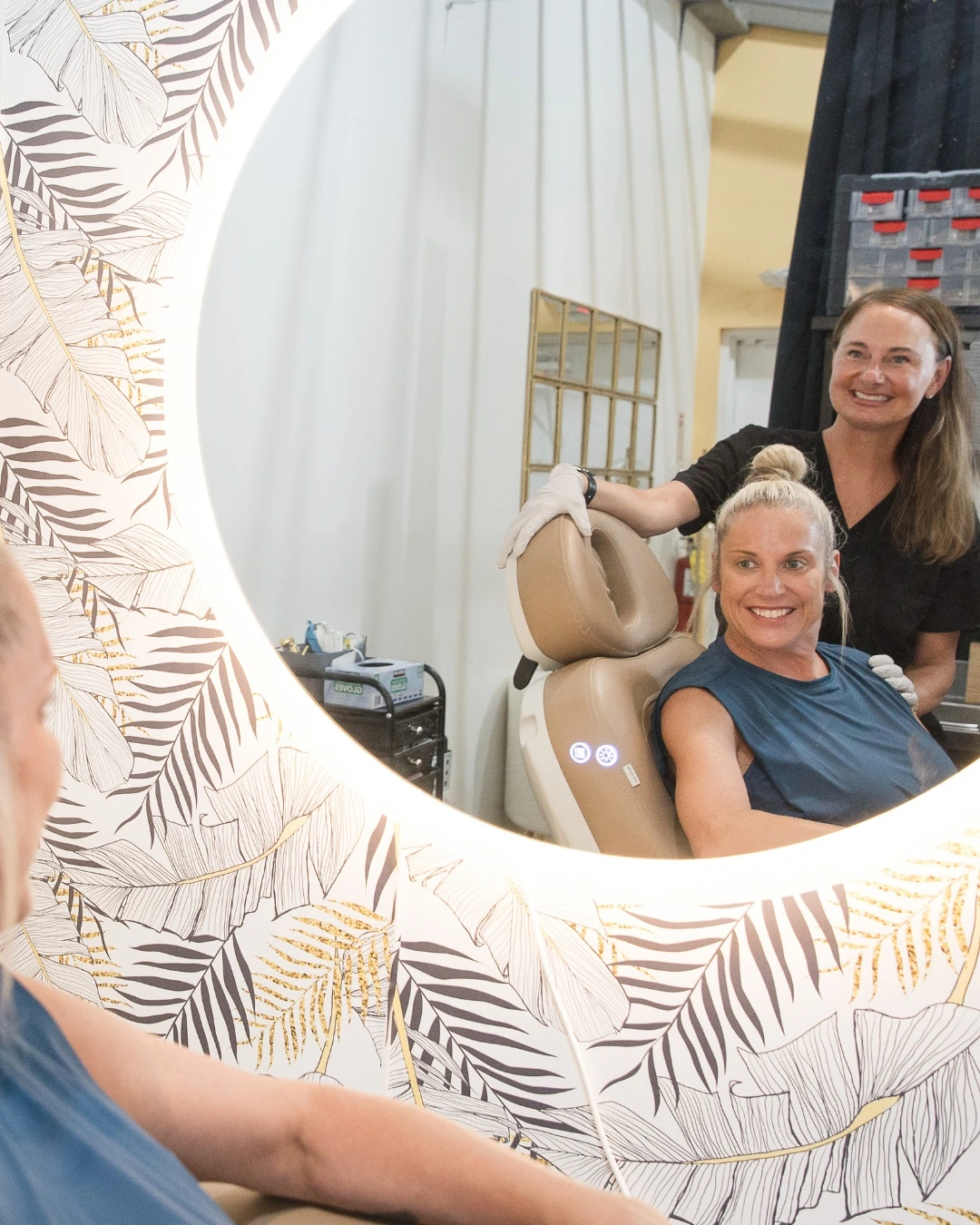
A typical combined protocol in my practice unfolds over several visits. I often begin with the filler work, restoring volume where the face needs structural support. PRP sessions follow or run alongside, targeting skin quality across the full face or in specific zones like the under eyes, where PRP performs particularly well and where filler placement demands extra caution.
Common pairings I design for women in their 40s include:
- Cheek or temple filler for structural restoration, combined with full face PRP microneedling to refine texture, minimize pores, and build collagen across the entire canvas
- Under eye PRP to thicken and brighten the delicate lower lid skin, paired with subtle midface filler that supports the under eye region from below
For clients who want to elevate skin quality even further between sessions, I sometimes incorporate AQUAGOLD microchanneling as a complementary treatment. And for those who prefer a structured, ongoing approach to maintenance, my GLOW Membership makes consistent care simple to sustain.
How Do I Keep Combination Treatments Safe?
Combining modalities requires more planning than performing either treatment alone, and this is where provider selection genuinely matters. As a board certified Nurse Anesthetist practicing since 2006, I bring an anesthesia background to every injectable treatment I perform, which shapes how I think about anatomy, sterility, and patient monitoring.
PRP carries an excellent safety profile because the material comes from your own body. Filler safety depends heavily on injection technique, product selection, and anatomical knowledge. When I combine the two, I sequence treatments to give each one the conditions it needs. I space sessions appropriately, I use conservative volumes, and I always have hyaluronidase on hand to adjust hyaluronic acid filler if ever needed.
Bruising and swelling are the most common side effects of either treatment, and both are typically mild and short lived. Most of my clients return to their normal routines the same day or the next morning.
Frequently Asked Questions
